
Wow real people.
Those were Peter Cheese opening words at the conference and I certainly identified!
Here’s my take on some of the other things Peter said that I felt were interesting/important:
- Instead of talking about the ‘great resignation’ Peter said his preference is to talk about the the great re-set or the great think. But to bear in mind if we don’t respond to this shift in expectations we will face the ‘great resignation’
- We need to work on inclusion in our own profession
- Varying challenges are forcing us to think stategically about the future – should we ‘Buy, Build, Borrow or Bot’ the skills we need. We need to consider how we shape jobs in the future to make best use of the skills that are available.
Peter also talked about the importance of wellbeing suggesting that as a profession we were (and should be) returning to our welfare roots. He added that we had lost sight of humanity and referred to a quote from Aristotle. I don’t believe he used a specific quote, or perhaps my mind wandered at that point, so I have taken the liberty of adding a couple myself (for completeness!)
“Happiness is the meaning and the purpose of life, the whole aim and end of human existence.”
“Pleasure in the job puts perfection in the work.”
Aristotle
Prof Lynda Gratton
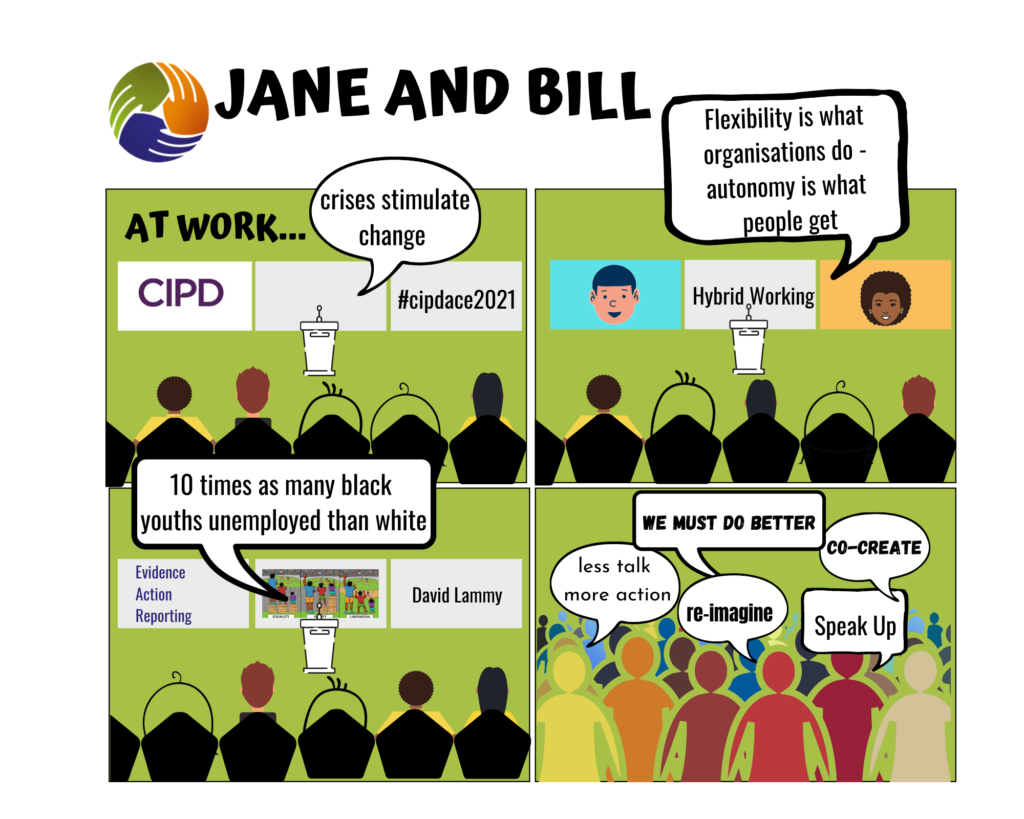
Our keynote speaker on Day One and Lynda was online – the hybrid conference in action! In her words Lynda’s aim was to give us ideas to help us think about our roles and the issues we’re facing. She added however that it would be a mistake to focus just on the pandemic when there are so many other trends at play:
- People are living longer – every 10 years we are are living (on average) another 2/3 years longer. The three stage life of Education, Work, Retirement does not work for employees or employers any more. We have to be more flexible and more adaptable.
- Technology doesn’t destroy jobs – it changes them
- Referencing Lewin’s 3 stage model of change (Freeze, Unfreeze, Refreeze) Lynda suggested she had “never known so many companies refreezing at the same time”
- Technology has been the star of the pandemic – advancing by at least 2 years.
- Hybrid is not going to last – we should be talking about flexibility
- Productivity has increased during the pandemic simply because people have been working longer hours
- Our short term focus should be on flexibility but long term this is a chance to redesign work
- There has been a loss of innovation through the pandemic. Our networks have been constricted as we have been spending more time with the people we know and less time with those with whom we have weaker ties
- We need to create opportunities, experiment – ask what people want, what does the job need, how does knowledge flow through the business (networks) and what is your peoples experience
- When thinking about flexibility we need to re-imagine place and re-imagine time
- Flexibility is/will be important – if you don’t offer it you will have to (generously) compensate people for not offering it as part of ‘your deal’
- Beware – if what you do doesn’t increase productivity then the change/solution won’t last
David Lammy
It was heartening to hear David say that ‘this time’ he believes the racism (diversity, inclusion) agenda is not going away. George Floyd and the Black Lives matter movement has accelerated it and geopolitics will, he said, ensure it stays on the table.
I made a note of some of the statistics he quoted, emphaising how important it is to have and understand this context:
- Half of all black boys in this country are born above the 4th floor
- 40% of black youth are unemployed; that is 10 times more than white
- Twice as many black people (than white) are on zero hours contracts
- Black people are 9 times more likely to be stopped and searched
- 2/3 unemployed people have a criminal record
He referred to the McKinsey report – Diversity wins: How inclusion matters as making a robust case for diversity including their finding that organisations with the highest profits were the most diverse.
David underlined the importance of gathering evidence, making action plans and reporting progress and cited Deloittes Black Action Plan as a good example (and as an example of not being shy to talk about black!).
Final thoughts
I attended several other sessions throughout the two days and as well as attending some really interesting talks and panel discussions it was great to meet up with people I hadn’t seen for ages and make some new connections. I thoroughly enjoyed it, it was a great event and well worth going to – I have a list of things to research and action and people to follow up!
But before I sign off here’s a couple of final observations/reflections from the conference:
First there was little disagreement or divergent thinking among speakers or panels. For a profession representing so many different industries, of different sizes and levels of maturity and geographical locations – we had speakers from as far away as Singapore and the UAE – I found this surprising and disappointing. For me it’s those different perspectives that spark real debate and creative thinking.
I was also struck by repeated calls for us as a profession to be braver and take the lead; to gather data and evidence to inform what we do, to get our people involved, to experiment and not feel we need to structure everything! We’re facing a massive agenda yet no-one seemed to be offering advice or ideas on how to approach it.
For me it just screams agile!
Agile puts your people at the heart of the solution, it’s evidence based, invites co-creation and experimentation instead of pilots so you can make a difference and add value sooner. We’ve been helping clients apply agile principles to their employee survey programs – set up and action planning. So if you’d like to find out how this may work for you please get in touch.